Why I Had a DEXA Scan at 40
By Jessica Corwin, MPH, RDN, NBCHWC
Last week, a large review of calcium and vitamin D supplementation made headlines. (Read the BMJ study here)
The researchers looked at 69 clinical trials involving more than 150,000 adults and found that calcium and vitamin D supplements provided little to no meaningful reduction in fractures or falls.
Predictably, the internet responded the way it always does.
"Calcium doesn't work."
"Vitamin D is useless."
"Everything we've been told is wrong."
I read the study and had a very different reaction.
My first thought was:
If calcium were the whole answer, osteoporosis would have been solved decades ago.
And my second thought was:
This is exactly why I had a DEXA scan at age 40.
Not because I thought something was wrong.
Not because my doctor told me I needed one.
I wanted a baseline. We all need a baseline. Otherwise, what — we wait until we break a bone at 60 only to discover then that we have low density?
Bone Loss Is Often Silent
One of the hardest things about bone health is that it doesn't usually announce itself.
If your cholesterol is high, you can run labs.
If your blood sugar is climbing, you can often see clues. (Learn more about the lab markers I review in midlife women)
If your sleep is falling apart, you'll definitely know. Been there. Don't want to go back.
But bone loss?
Bone loss can happen quietly for years.
Many women don't discover they have osteopenia or osteoporosis until they're already seeing significant changes on a scan or — worse — after a fracture occurs.
As someone who works with women in midlife every day, I wanted information.
I wanted context.
I wanted to know where I was starting.
Because the earlier we identify a problem, the more options we have.
The Bone Health Conversation Is Too Small
For years, we've reduced bone health to two nutrients:
Calcium.
Vitamin D.
Both matter.
Calcium is a major structural component of bone. Vitamin D helps us absorb and utilize calcium.
But bone health is far more complex than a supplement aisle at the grocery store.
Bone is living tissue.
Your skeleton is constantly remodeling itself.
Old bone is broken down. New bone is built.
That process is influenced by nutrition, hormones, movement, muscle mass, sleep, medications, genetics, and aging.
Which is why I wasn't surprised by the findings of this latest review.
The study didn't convince me that calcium is unimportant.
It reminded me that calcium was never the whole story.
The Best Bone Health Advice I Ever Received Didn't Mention Calcium
Years ago, I worked alongside an orthopedic physician who treated osteoporosis regularly.
One day he said something that has stayed with me ever since.
He told me he believed one of the biggest reasons he saw women develop osteoporosis was because they simply weren't eating enough protein. Actually, he said they were "under protein'd." Nearly the opposite of what I was taught in school, where I was told too much protein was actually harmful to bone.
At the time, I remember thinking:
Really? Protein?
Not calcium?
Not vitamin D?
Not magnesium?
Protein.
The more I've learned over the years, the more I think he was onto something.
Because bone isn't just mineral.
Bone is built upon a protein framework called collagen.
The calcium, phosphorus, and other minerals are deposited onto that framework.
Without the framework, there is nowhere to build.
Yet many women spend decades trying to eat less.
Less food.
Less calories.
Less protein.
Less of everything.
Then menopause arrives.
Muscle becomes harder to maintain.
Bone loss begins to accelerate.
And suddenly we're looking for a supplement to fix a problem that may have been developing for years. (I see this pattern often in women who are gaining weight after 40 despite eating what they think is "healthy.")
Strong Bones Need Strong Muscles
If there is one thing I wish more women understood about bone health, it's this:
Strong bones and strong muscles are teammates.
You rarely find one thriving without the other.
Every time you strength train, carry something heavy, climb stairs, hike a trail, or challenge your muscles, you're sending signals throughout your body.
You're essentially telling your bones:
"Hey, we still need you."
Your body responds.
This is one reason resistance training consistently shows benefits for preserving both muscle and bone as we age.
It's also one reason I spend so much time encouraging women to move beyond the idea that exercise is only for burning calories.
Some of the most important benefits of strength training have nothing to do with weight loss.
They have everything to do with preserving independence.
Bone Health Is a Team Sport
When I think about supporting healthy bones, I'm thinking about much more than calcium.
I'm thinking about:
- Protein — the collagen framework your minerals need (how much protein women over 40 actually need)
- Resistance training — the signal that tells bone to stay strong
- Regular movement — daily loading, not just gym time
- Vitamin D — helps absorb calcium, supports muscle function
- Calcium — a structural player, not the whole strategy
- Magnesium, Vitamin K, Zinc, Copper, Boron — cofactors that matter
- Sleep — recovery and hormone regulation
- Hormonal health — estrogen's role in bone remodeling
- Balance and fall prevention — because fractures are the event we're trying to avoid
Bone health is a team sport.
Calcium is one player on the roster.
Not the entire team.
So Should You Stop Taking Calcium?
Not necessarily.
This study doesn't mean calcium is useless.
It doesn't mean vitamin D deficiency doesn't matter.
It doesn't mean supplements never have a place.
Many women struggle to meet calcium needs through food alone. Others have low vitamin D levels, especially those of us living in northern climates.
Those situations deserve individualized conversations.
The bigger lesson is that supplements cannot replace the foundations.
No pill can create muscle for us.
No supplement can strength train for us.
No capsule can make up for years of under-fueling.
What I Hope Women Take Away From This
Midlife isn't about doing less.
It's about doing what works for your body with more awareness and more grace.
If you're worried about osteoporosis, don't stop at calcium.
Ask bigger questions.
- Am I eating enough protein? - Am I strength training? - Do I know my bone density? - Have I checked my vitamin D? - Am I building the habits that support strength for the next 30 or 40 years?
Because the goal isn't simply to avoid a fracture someday.
The goal is to keep hiking.
Keep traveling.
Keep carrying your own groceries.
Keep getting up from the floor.
Keep playing with grandchildren.
Keep living fully.
And that work starts long before osteoporosis ever appears on a report.
A Note on the DEXA Scan Itself
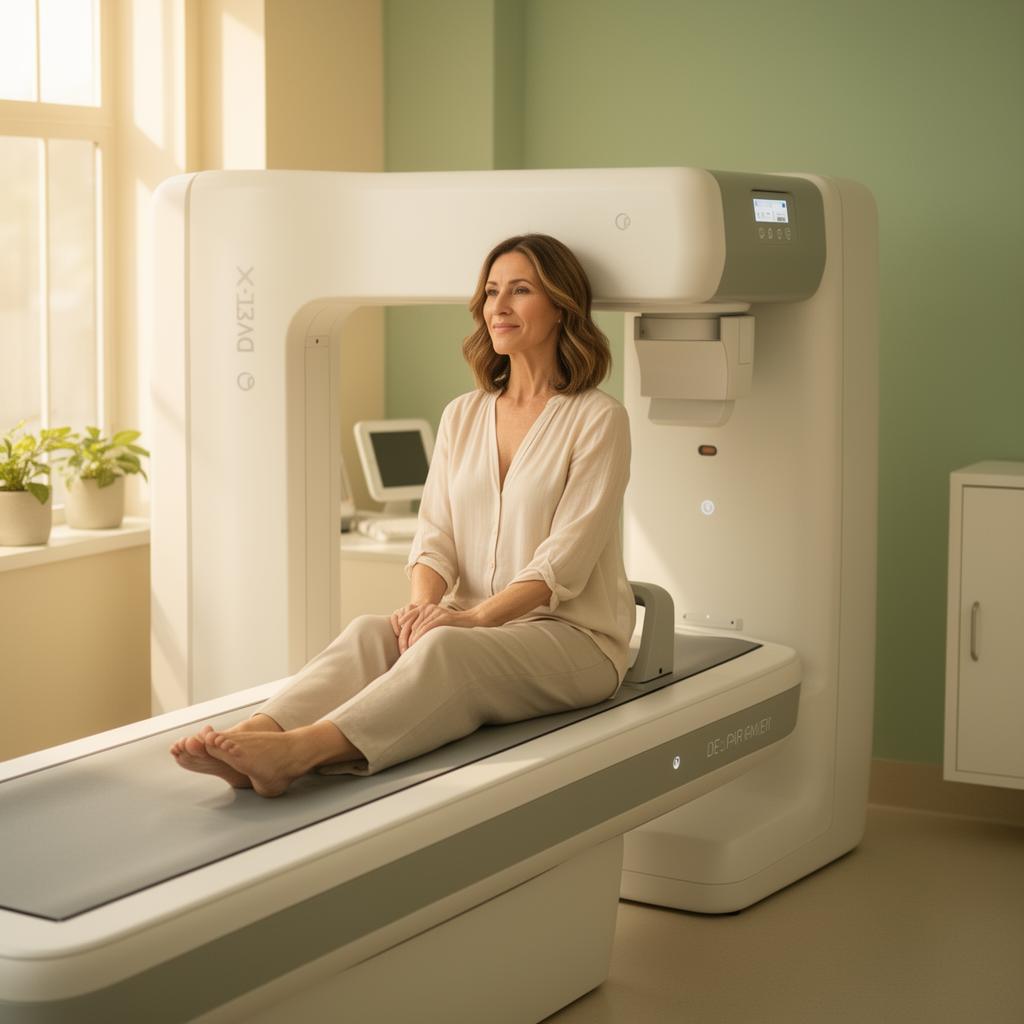
If you're curious about the experience: a DEXA scan is quick, painless, and non-invasive. You lie flat for a few minutes while a low-dose X-ray measures bone density at your hip and spine.
Results are given as a T-score, which compares your bone density to that of a healthy young adult. A T-score between -1.0 and -2.5 indicates osteopenia (low bone mass). Below -2.5 indicates osteoporosis.
But here's what I want you to remember:
A DEXA scan is not a verdict. It's information.
If your results show low density at 45, you have time. You have options. You have leverage.
If you wait until 65, your window for meaningful intervention is smaller.
Start With Context, Not Crisis
If you've never thought about your bone health before, consider this your gentle nudge.
I had my first DEXA scan at 40 because I wanted a baseline.
You don't have to wait for a problem to start paying attention.
If you're navigating midlife and wondering where to focus first, my Midlife Metabolic Scorecard walks you through the key areas — including the metabolic, nutritional, and lifestyle patterns that influence how you feel, function, and age.
And if you'd like to talk through what your own labs, symptoms, or concerns might be telling you — including whether a DEXA scan makes sense for you right now — you can book a free 15-minute strategy call here.
The best time to understand your body was yesterday. The second best time is now.