Protein After 40: How Much Women Really Need (and Why It Changes)
By Jessica Corwin, MPH, RDN, NBCHWC
By Jessica Corwin, MPH, RDN, NBCHWC — Registered Dietitian Nutritionist and National Board Certified Health and Wellness Coach with 20+ years of clinical experience in women's midlife health.
Your Body Isn't Failing — Your Protein Needs Have Changed
If you're in your 40s or 50s and doing everything "right" but your body feels like it's responding differently, I want you to hear this first:
You're not failing. Your physiology is shifting.
I hear this constantly in my clinical practice. Women sit across from me and say quietly, "I'm eating the same way I always have."
And they're telling the truth.
The rules changed. No one explained why. One of the biggest shifts no one prepares women for is protein — how much you need, when you need it, and why the amount that worked at 30 may not be enough at 48.
In this article, you'll learn why protein needs increase after 40, how much research supports for midlife women, why meal distribution matters as much as total intake, and how to apply this practically without overcomplicating your life.
Why Protein Needs Increase After 40: Anabolic Resistance
After 40, and especially during perimenopause, your body becomes less efficient at building and maintaining muscle from the protein you eat. Researchers call this anabolic resistance.
In your 20s, a modest amount of protein triggered muscle repair easily. In your 40s and 50s, your body requires a stronger signal.
Declining estradiol plays a central role. Estrogen helps regulate:
- Muscle maintenance and repair
- Insulin sensitivity
- Fat distribution
- Appetite signaling
As estradiol fluctuates and declines, muscle loss accelerates and metabolic flexibility weakens.
This isn't cosmetic. Muscle is metabolic tissue — it's protective tissue. Loss of lean mass is associated with insulin resistance, higher cardiometabolic risk, and reduced long-term function.
Midlife isn't about shrinking. It's about preserving strength.
How Much Protein Do Women Over 40 Really Need?
The current RDA for protein is 0.8 g/kg body weight. That number was designed to prevent deficiency. It does not optimize muscle preservation in midlife.
Research in aging adults consistently supports higher intakes:
- General recommendation: 1.2–1.6 g/kg/day
- Active women or those strength training: 1.6–2.0 g/kg/day
Key references include Morton et al., 2018 in the British Journal of Sports Medicine and Phillips & Fulgoni, 2016 in Advances in Nutrition.
How I Approach This in Clinical Practice
In my work with midlife women, I typically guide clients toward approximately 1.6 g/kg of desired body weight, sometimes closer to 2.0 g/kg depending on strength training volume and metabolic health markers.
For a 150-pound woman, that translates to roughly 80–110 grams per day.
But here's the nuance most articles skip: it's not just how much protein you eat. It's how you distribute it across the day.
A woman eating 80 grams of protein — but 60 of those grams at dinner — will not get the same muscle-preserving benefit as a woman eating 25–30 grams at each of three meals.
Why ~30 Grams Per Meal Matters: The Leucine Threshold
When I suggest aiming for around 30 grams of protein per meal, it's not random. It's because of something called the leucine threshold.
Leucine is an amino acid that acts as the "on switch" for muscle repair. It activates mTOR signaling and initiates muscle protein synthesis.
In younger years, that switch was sensitive. In midlife, you have to press harder.
Research suggests aging adults need approximately 2.5 grams of leucine per meal to maximally stimulate muscle protein synthesis — typically corresponding to 25–35 grams of high-quality protein per meal (Katsanos et al., 2006; Moore et al., 2015).
A 10-gram protein breakfast won't do much for muscle signaling at 48. A 30-gram breakfast will. Distribution matters.
What 30 Grams of Protein Looks Like (Real Food Examples)
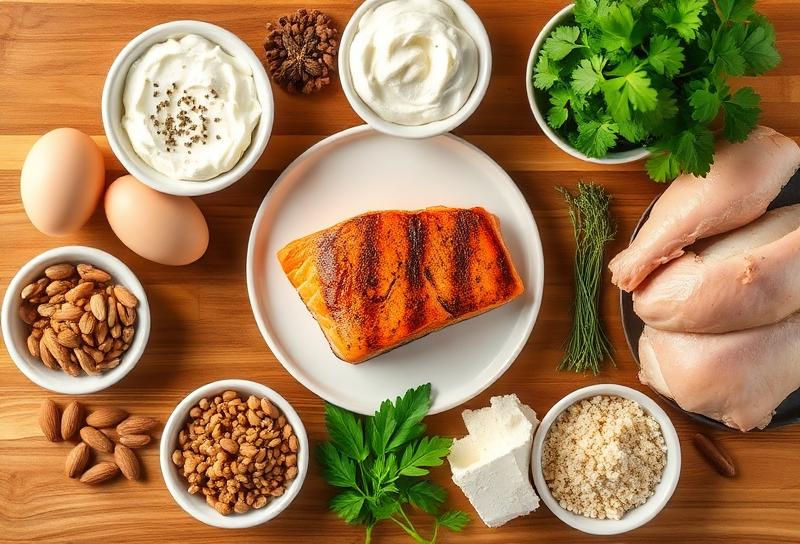
Hitting 25–35 grams per meal doesn't require supplements or complicated cooking:
- Breakfast: 3 eggs + spinach + whole grain toast ≈ 25g
- Breakfast: Greek yogurt (1 cup) + berries + nuts + chia seeds ≈ 28g
- Lunch: Turkey + arugula wrap with 4–5 oz turkey ≈ 30–36g
- Lunch: Rotisserie chicken + quinoa + vegetables ≈ 30g
- Dinner: 5 oz salmon + sweet potato + broccoli ≈ 35g
- Dinner: Lentils + rice + sautéed greens + pumpkin seeds ≈ 28g (plant-based)
For more complete meal frameworks, see my Protein Reset guide with 7 busy-mom meal ideas.
The Pattern I See in Perimenopause
Here's a pattern I see constantly in practice:
- Morning hunger fades - Coffee replaces breakfast - Lunch is light — maybe a salad, maybe skipped - By 3pm everything unravels
The crash. The cravings. The "what is wrong with me?" spiral.
That's not willpower failure. That's blood sugar instability layered on hormonal shifts.
Protein, Blood Sugar, Brain Fog, and Energy
Declining estradiol impacts insulin sensitivity. Many women in perimenopause notice:
- Fasting glucose creeping up - Triglycerides climbing - Afternoon energy crashes - Brain fog - Stronger carb cravings
Protein helps stabilize all of this by:
- Slowing gastric emptying — food digests more gradually
- Reducing post-meal glucose spikes
- Lowering insulin demand
- Stimulating satiety hormones like GLP-1 and PYY
See Gannon & Nuttall, 2010 in the Journal of Nutrition.
When blood sugar is steadier, energy is steadier. Mood is steadier. Cravings soften. Brain fog often lifts. Protein becomes a stabilizer.
Is This Harder If You're Plant-Based?
If you follow a plant-based eating pattern, this conversation requires more strategy — but it absolutely works.
Plant proteins often contain lower leucine density per gram and have slightly lower digestibility. That means you may need:
- Slightly larger portions to reach the leucine threshold
- Intentional combinations of legumes and grains
- Emphasis on higher-protein plant foods like soy, tempeh, lentils, and pea protein
I often help plant-forward clients reach their targets through mixed patterns. Well-planned plant-based approaches can preserve muscle effectively.
Is High Protein Safe for Heart Health?
A 2024 paper in Nature Metabolism raised concerns that very high protein intake — particularly leucine-heavy animal protein — may activate immune pathways involved in plaque development (read the study).
Important context: This was a mechanistic study using cellular and animal models with short-term feeding data. It did not measure long-term cardiovascular outcomes in humans and does not establish cause and effect.
When we look at large prospective human data, we do not see consistent increases in cardiovascular events with higher protein intake overall, especially when sources are lean and plant-inclusive (Song et al., 2016 in JAMA Internal Medicine).
This is why I emphasize variety, minimally processed protein sources, fiber-rich vegetables, Mediterranean-style patterns, and avoiding extremes. Nutrition science evolves. Context matters.
Is Protein Safe for Kidneys After Menopause?
This concern comes up frequently. Current evidence does not support the idea that higher protein intake causes kidney damage in women with healthy kidney function.
A comprehensive review by Devries et al., 2018 found no adverse effects of higher protein diets on kidney function in healthy adults.
If you have pre-existing kidney disease or impaired kidney function, work with your healthcare provider to determine appropriate protein levels. For generally healthy midlife women, intakes in the 1.2–2.0 g/kg range are well within safe parameters.
Hunger Signals Change in Midlife
As estradiol declines, satiety signals can weaken. Lean mass declines. Basal metabolic rate shifts. Cravings can intensify. Hunger cues may not be as loud or reliable.
Protein amplifies satiety hormones. But many women under-eat protein simply because morning hunger feels muted.
That does not mean your body does not need it. Intentional protein intake can help restore rhythm even when hunger cues feel different.
The Bottom Line
Muscle is not vanity tissue. It is a metabolic organ. A glucose disposal site. A predictor of independence. Protective against falls. Associated with longevity.
Loss of lean mass accelerates during perimenopause and postmenopause. Resistance training combined with adequate protein intake remains one of the most evidence-supported strategies we have for preserving function with age.
Your body is not broken. It is adapting.
In midlife, protein becomes a strategic lever for muscle preservation, blood sugar stability, satiety, cognitive clarity, and long-term resilience. The signal simply needs to be stronger than it used to be.
Frequently Asked Questions
How much protein should a 50-year-old woman eat per day? Most midlife women benefit from 1.2–1.6 g/kg of body weight daily, and up to 2.0 g/kg if strength training regularly. For a 150-pound woman, that's roughly 80–110 grams per day, ideally distributed across 3–4 meals.
Can you get enough protein without supplements? Yes. Whole foods like eggs, poultry, fish, Greek yogurt, cottage cheese, lentils, and tofu can meet most women's needs. Protein powder can be a convenient addition, but it's not required.
Does protein help with perimenopause weight gain? Protein supports lean mass preservation, blood sugar stability, and satiety — all of which influence body composition in midlife. It's one piece of a larger picture that includes strength training, sleep, and stress management.
When is the best time to eat protein? Research supports distributing protein across all meals rather than loading it at dinner. Aim for 25–35 grams per meal, starting with breakfast.
Is too much protein bad for you? For generally healthy women, intakes up to 2.0 g/kg/day are well-supported by research and show no adverse effects on kidney or cardiovascular health. If you have pre-existing conditions, work with your provider.
Important Note
This article is for educational purposes and is intended for generally healthy women. It is not individualized medical or nutrition advice. If you have kidney disease, liver conditions, or other medical concerns, consult your healthcare provider before making significant dietary changes.
If you want personalized support navigating midlife metabolism, blood sugar shifts, and strength preservation, you can learn more about working with me 1:1 here.
Midlife isn't about eating less. It's about eating with intention. And protein is one of the most powerful tools we have.
Weekly Midlife Nutrition Clarity
Join the newsletter for evidence-based insights on protein, blood sugar, hormones, and midlife wellness — plus get the free Midlife Reset Checklist.
References
- Morton RW et al. A systematic review, meta-analysis and meta-regression of the effect of protein supplementation on resistance training-induced gains in muscle mass and strength. Br J Sports Med. 2018;52(6):376-384. Link
- Phillips SM, Fulgoni VL. Protein "requirements" beyond the RDA. Adv Nutr. 2016;7(3):357-395. Link
- Katsanos CS et al. Aging is associated with diminished accretion of muscle proteins after the ingestion of a small bolus of essential amino acids. Am J Clin Nutr. 2005;82(5):1065-1073. Link
- Moore DR et al. Protein ingestion to stimulate MPS. Appl Physiol Nutr Metab. 2015;40(10):1002-1009. Link
- Gannon MC, Nuttall FQ. Effect of a high-protein, low-carbohydrate diet on blood glucose control. J Nutr. 2010;140(3):558-563. Link
- Song M et al. Association of animal and plant protein intake with all-cause and cause-specific mortality. JAMA Intern Med. 2016;176(10):1453-1463. Link
- Devries MC et al. Changes in kidney function do not differ between healthy adults consuming higher- compared with lower- or normal-protein diets. J Nutr. 2018;148(11):1760-1775. Link